WHILE the story behind Diwali and the manner of celebration vary from region to region, for Hindus, Diwali is one of the most important festivals of the year.
Families celebrate by performing traditional activities together in their homes. However, this event takes on its own life with persons from all walks of life playing a part as either a spectator or participant in the festival of lights.
The celebrations feature festive fireworks, worship, sharing of sweets and lighting of diyas. Traditionally, Diwali marks the end of the harvest season. Farmers give thanks for the bounty of the year gone by, and pray for a good harvest for the year to come.
While Diwali is popularly known as the “festival of lights”, the most significant spiritual meaning behind it is “the awareness of the inner light”. The celebration of Diwali as the “victory of good over evil” is a holiday of joy; it is the time when devotees gather with loved ones, celebrating family, friends and the prosperity God has bestowed upon us. Diwali also marks the New Year.
For some, the day of Diwali itself is the first day of the New Year, and for others, the New Year’s Day is the day following Diwali. But, for all, this season is one of heralding in the New Year. On this day, devotees clean every room of the house; they dust every corner of the garage, sweep behind bookshelves, vacuum under beds and empty out cabinets. But, what about our hearts? When was the last time we swept out our hearts? When did we last empty them of all the dirt and garbage that accumulated throughout our lives?
This is the true focus of the festival, the inward light of higher knowledge dispelling all ignorance, the ignorance that masks one’s true nature, not as the body, but as the unchanging, infinite, immanent and transcendent reality.
With this awakening comes compassion and the awareness of the oneness of all things (higher knowledge). This brings joy or peace. According to the Hindu calendar, Amavasya or ‘no moon day’ is considered as the perfect day to celebrate Diwali. This dark night comes after every fortnight and in the month of Kartik, it marks this festival of lights and diyas. According to the English calendar, the festival generally comes in the month of November or December.
Diwali is celebrated for many reasons; but the most commonly known reason is to celebrate the day Sri Rama, Sitaji, and Lakshman returned from their exile of 14 years in the forest – symbolizing a win of goodness over evil. By the Hindu calendar, it also marks the start of the New Year calendar.
In fact, Diwali is considered so auspicious that it is celebrated with families and friends over five days. For many Hindus, this five-day festival honours Lakshmi, the goddess of wealth. Many Hindus have already cleaned their places of abode which, according to tradition, welcomes the goddess of wealth who is also associated with the festival. If a partaker is away from the sights and sounds of Diwali, light a diya, sit quietly, shut your eyes, withdraw the senses, concentrate on this supreme light and illuminate the soul.
Letting go of control seems almost impossible. How do you let go of control when you’re afraid things will go wrong? How can you let go of what you fear? Still, letting go of control is possible, with the insights in this article.
The more control we want, the more tension we get in return. Because many things can we just can not control.
There are 3 simple questions that hardly anyone asks themselves. When you answer these questions, you automatically let go. And you can apply this to any area of your life.
Letting go gives you relaxation, confidence and inner strength. Let it go!
What can you control – and what not?
We have no control over the future, because no one knows exactly what will happen. We have no control over other people because they just do what they want to do.
If you think carefully, you will see that you cannot control many situations and people. You really only have control over what you do – here and now .
If you can’t change something, you can only accept and let go. This often feels unnatural, because control is part of our system. We have the illusion that we can influence almost everything.
Well, if it were, your life would be absolutely perfect, wouldn’t it?
Then you had already arranged that yourself …
Exercise in letting go – in every area.
You can apply the following exercise in any area of your life. You can practice this every day, in any situation. It does not matter whether it is about letting go of financial worries, relationship problems or worries about the future.
Letting go is the solution to all stress and worries. The essence is always this: too much control creates tension. In any field!
When you try to control something, something controls you too. When you let go of something, you are free.
The next time you feel tension, ask yourself the following three questions:
Letting go of control – question 1: What am I trying to control?
What is causing my inner turmoil? Do I want a guarantee for the future? Am I trying to determine what someone else should do? Am I concerned with the past? What makes me feel insecure?
Find the core of that tension. What are you trying to control or change? For instance:
1. I regret that I made that choice then. 2. Why did he do it that way? 3. I hope he keeps his promises! 4. She won’t react like that again, will she? 5. I want the assurance that this choice is the best for my future. 6. I hope everything goes well next week.
Then ask yourself the following question:
Letting go of control – question 2: Can I actually control that?
That’s a simple question that most people never ask themselves.
Can you really change this? Do you really influence here? Is this within your control?
There are two options:
a) Yes, you can do something about this. Great – stop worrying and do it! b) No, you have no influence (anymore) on this. Then you can only accept this and let it go.
Letting go of control – question 3: Am I willing to let it go?
We usually do not get around to this step either. We intellectually understand that we have to let go of something, but we just don’t want or ca n’t.
Why not? Because we still feel too many negative emotions: fear, uncertainty, doubt, regret, frustration, etc.
Yet there is one very good reason to let it go: Because letting go helps yourself . Because you hold with yourself disadvantage . It’s just in your best interest.
And after you make this decision, your emotions automatically start to change. Then your emotions become positive and relaxed again.
Make the decision now:
“Yes, I realize that I am only hurting myself by sticking to what I cannot (anymore) change at the moment. In the interest of my own mental and physical health, I decide to let go of this. I know it will make me feel better. So I am willing to let it go. ”
The final step: Let it go!
Now you have seen what you are trying to control. You have seen that you cannot control it. You know you have to let it go. And you are willing to actually let it go.
Congratulations! Now you are ready for the final step: Let it go!
Use a short sentence (also called a belief, affirmation, autosuggestion, or mantra) to help you through this step.
Your own words are always the best!
Here are some examples you can use:
1. It’s okay. 2. I let go. 3. It is the way it is.
4. I’m at peace with it. 5. I forgive myself. 6. I forgive him / her.
7. I accept it. 8. It’s good enough. 9. I let it rest.
Pay attention! This exercise is not a one-off.
You will have to repeat this often. It is an illusion that we suddenly start to feel everything differently. But you will definitely feel different when you practice with this!
There is no other option: repetition is the mother of every skill.
And lasting relaxation is the result of regular practice of letting go.
Relaxation becomes a habit if you keep practicing.
Keep in mind that sooner or later check comes up again and says:
“Hey, not too relaxed! Come on, we have so much to plan, check, change. You still have to worry, worry and think about the past. You still have to worry about everything! ”
Control is a habit – and habits keep coming back. Especially in the beginning. But keep practicing.
You will find that each layer you release in one area helps you in other areas as well. If you let go of control at work, you can also do that in your relationships. The gist is always the same, remember?
Let it goooooo!
Letting go is an art that you can refine throughout your life. There is no end point, we can always let go of something deeper.
To say it with Elsa from the animated film ‘Frozen’: Let it goooooo!
With every layer of tension you release, you gain access to a hidden layer of energy and well-being. Do you have any idea how many extra layers of energy and well-being are still waiting for you? Can you imagine how good you would feel learning to tap it?
Do you want to find out? Do you want more relaxation and more energy?
Go on research and make the best choice to take actions….
Happy relationships are no accident. Neither are unhappy relationships. They are the result of conscious choices:
1 – Love and trust are handled differently
from unhappy relationships.
2 – There is more depth and more is shared.
3 – Both partners are emotionally independent and appreciate this in each
other.
Do you have to end your relationship
immediately in case of relationship problems? No Fortunately not!
Learn from the lessons of happy relationships
and apply them to avoid a lot of relationship problems.
Just read the comments below …
How do you get a happy
relationship with someone else?
What is a Happy Relationship? Very
simple, that is a relationship that gives you energy and where you and the
other feel good. The secret to a happy relationship is to stay yourself
and let the other person remain themselves.
How do you get a happy relationship? By
working on it. But… you have to know very well if you have the right
partner to do that. You cannot fly with a boat, so the choice of your
relationship partner is very important.
Happy without a
relationship or happier with a relationship?
Better happy without a relationship than not
happy while you are in a relationship, isn’t it? In a happy relationship
you don’t test each other, you trust and support each other. If not, then
you may be better off without the other. You don’t have to have a huge
spiritual relationship, but love and trust do have to be there.
These pillars of a relationship always remain
important, whether you are in a long relationship or a short relationship with
someone.
These are the seven TOP tips for a happy
relationship:
1. Love makes for a
happy relationship.
In unhealthy relationships, love is a bargaining chip: “I only
love you if you do this for me. And
when it does, I hate
you. “
Love is a means to an end, which is to gain
control over the relationship.
Unfortunately, control and happiness are at
odds with each other. So trying to get control in your relationship (by
trying to control the other) and being happy in your relationship don’t usually
go together.
For example: As long as you do what the other
wants, there is love. And otherwise there is the opposite: anger,
aversion, jealousy or envy. So love is very limited and usually just a
snapshot.
Set conditions for
your happiness.
In happy relationships, few conditions are placed on
love. “I love you just the way you are.” Or: “As long
as you do what makes you happy, I’m too happy.” This
allows love to grow.
And love only grows in trust, not in control,
because control is based more on fear and fear hooks on love.
So let go of control:
The more you feel that the other person loves
you the way you are, the more you can be yourself – and the more love you can
give back.
2. No happy
relationships without trust.
There is little trust in unhappy relationships. Whenever
you are hurt by the other person’s behavior, trust diminishes. In the end
you take everything the
other says with a grain of salt. Without trust there is no love, depth,
intimacy or understanding, so the relationship becomes increasingly distant.
People in happy relationships trust each other
blindly. They know exactly what they can do for each other. Perhaps
it took a long time for this confidence to be established. But once
present, it continues to feed the relationship with positive energy. You
know that the other person wants the best for you – and vice versa of course.
Trust is the most important ingredient to a
happy relationship, be it a relationship with your partner, with your friends
or with colleagues. Trust is everything.
3. Depth is necessary
for every relationship.
In less good relationships communication is
superficial. You never know what is really on the
other’s mind – or you don’t feel the need to tell them what’s on your mind . As a result, conversations never
get to the core: what someone really thinks or feels. There is a lot of
talk about situations (what messages have been done, what the weather forecast
is), but little about deeper feelings.
In happy relationships, that depth is
there. There is talk about what really concerns the other. When you
share the bed, you are physically intimate. When you share feelings, you
are emotionally intimate. Without intimacy, there is only distance. Depth
is essential to avoid that.
4. Sharing makes happy
relationships even better.
Little is shared in superficial
relationships. It seems as if everyone leads their own life and only lives
together by chance. Interests are not shared, experiences are not
exchanged and ideas are not discussed. The relationship resembles two
islands with a very long bridge in between. You can only share by
crossing. But usually that is a bridge too far. Everyone stays on
their own island …
In happy relationships, a lot is shared (not
everything, as there may be a part that you would rather share with others or
keep to yourself). That sharing creates a bond. Sharing is giving
something away and then receiving it twice back. As they say:
“Sharing is caring.” Two islands have converged …
5. Laughter is healthy
for any relationship.
There is little laughter in bad relationships. Everything
is heavy and serious. There is usually no ability to put things into
perspective. Sometimes people escape this
by seeking pleasure outside of the
relationship. “She’s always so serious, I just want to have fun with
my friends.” Or: “He sees everything so black, at least with my
best friend I can laugh …”
Happy relationships do involve a lot of laughter. Laughing
together – even if it’s just about your own shortcomings – is so
liberating! What do you do when you’ve had a rough day? Sometimes you
just don’t feel like talking about it. Then you feel better at a comedy or
a pillow fight. A day without laughter is a day wasted. Laughter
provides light, warmth and relaxation. Smile, damn!
6. Without
independence there is only dependence.
In difficult relationships there is always some form of
dependence. One partner is dependent on the other. It doesn’t even
have to be financial dependence. More often it is an emotional dependence. It’s as if one of the
two cares less about what the other does. The person who has the least to
lose if the relationship ends is the one who determines the relationship.
In healthy relationships there is equality. Two people
decide: “We feel fine without each other, but even better
together. We choose to be
together. Not out of necessity or poverty, but out of love. ” Both
people value each other and do not allow one to prevail or determine the
relationship.
7. Appreciation is
necessary for all happy relationships.
In bad relationships, the focus is very much on what the partner
is doing wrong. “I say it every time, but you never get it right!” Or: “When will I
get through to you?” Since the focus is on the other
person ‘s shortcomings , there is a lot
of dissatisfaction. More attention is paid to what is not there than to what is.
Happy couples appreciate each other.
1 – You know that the other is not perfect.
2 – You have no desire to change him or her.
3 – You forget the small mistakes and focus on
what you do appreciate.
You cannot appreciate someone until you stop
focusing on their flaws. That does not only apply to your relationship,
but also to yourself!
Do you want a happy
relationship with other people?
With your partner, or with your family,
friends or colleagues?
Then you need more insight – and you also need to work on
yourself. Because a good relationship always starts with a good
relationship with yourself .
Hello Everyone. In this article I will try to explain the Brookfield Reflection Model in a practical way. After reading you will understand the basics of this powerful communication tool. Get ready and move on. . .
What is the Brookfield
Reflection Model?
The Brookfield Reflection Model is a tool for
teachers to discover the value of their lessons through critical
self-reflection. Brookfield states that critically reflective teachers and
tutors are excellent teachers who can authentically convey their own voice to
others.
As teachers reflect more and better, they are
better able to make reliable and accurate judgments about teaching approaches,
evaluation, planning curriculum design, assessments and dealing with student
problems. It is therefore crucial to perform these responsibilities with a
critical evaluation from as many different perspectives as possible.
Many schools encourage teachers to think
critically about their own teaching and student learning using Stephen
Brookfield’s four different interconnections. These four reads are used
for critical self-reflection, as well as by developing a critically reflective
teacher.
Who developed the
Brookfield reflection model?
The Brookfield Reflection Model was developed by Stephen Brookfield in 1995. Brookfield has taught in several countries during his teaching career. Among others, he taught in the United States, England and Canada. During his career Brookfield wrote nineteen books. The topics of these books ranged from critical thinking, discussion methods, critical theory and learning racing. His goal has always been to help adults learn to think critically about the dominant ideas that each person has internalized.
What are the four
reads of Brookfield’s critical reflection?
According to Brookfield, critically reflective
teachers provide three benefits:
Inspiring confidence
Achieving SMART goals
Motivated, critically reflective students
The goal of the critically reflective teacher
is to acquire a greater awareness of her or his own teaching from as many
points of view as possible. For this Stephen Brookfield has developed four
reads in the Brookfield reflection model. These can be used by teachers in
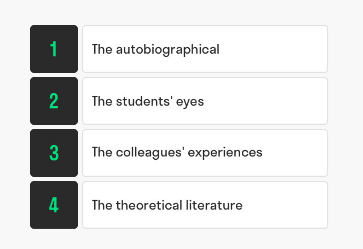
the process of critical reflection. It concerns the following four reads,
or perspectives:
The autobiographical lens
The eyes of the student
The experiences of colleagues
Theoretical literature
These reading correlate with the processes of self-reflection, feedback , peer review, and deliberation on scientific literature. By continuously improving these processes, the foundation is laid for better education and the means to become a good teacher.
1. The
autobiographical lens
This is the first lens of the Brookfield
reflection model, and is also where a teacher can reveal aspects of pedagogy that
may need to be enhanced or modified. The autobiographical lens helps
teachers to consider their own experiences with students in relation to
teaching and learning. The analysis of this learning experience will help
uncover assumptions and beliefs about how people learn.
Aspects of their pedagogy can be revealed
through textbooks, evaluations, student feedback, personal results or other
techniques. Self-reflection is the basis for reflective education.
Activities within the
autobiographical perspective
Philosophy of Education and Learning
Recordings
Education logs
Audits
Opinions
2. The eyes of the
student
It is necessary to go beyond mere reflection
through the autobiographical lens. According to the Brookfield reflection
model, it is of the utmost importance that teachers understand the experiences
of students. Teachers can do this by, for example, conducting evaluations
with students, about learning styles, testing methods, focus groups or
interviews. This ensures that they will teach more responsibly. The
student lens further reveals whether assumptions about power relationships need
to be adjusted, as well as student learning habits through feedback.
Activity perspective
of the student
Formal Evaluations
Classroom evaluations
Focus groups
Conversations
Letters
Questionnaires
3. The experiences of
colleagues
Good teachers keep their focus on the first
two lenses, but excellent teachers will also be deeply involved in those
processes, as well as reaching out to peers for mentoring, advice and
feedback. In addition, teachers can gain confidence through contacts with
other teachers. That’s because they discover that they are not the only
ones who make strange mistakes, but that they are shared by peers. Also
exchange experiences in the field of working in teams, participating in
seminars, workshops, peer reviews, or thinking about educational theories and
methods.
Activities experiences
of colleagues
Learning circles
Collaborative Problem Solving
Critical interviews and evaluations
4. The theoretical
literature
The fourth and final lens of the Brookfield
reflection model for critical reflection in education is contained in the
scientific literature on higher education. Teachers who research, present,
or publish this literature have advanced vocabulary and many methods of
teaching practice. A commitment to both scientific literature and
colleagues supports teachers.
Activities theoretical
literature
Conferences
Trade magazines
Research
Tips for introducing
critical reflection in education
As a teacher it is sometimes difficult to
apply new methods or techniques while teaching. Use the step-by-step plan
below to stimulate critical reflection in the students.
Tip 1: arouse
curiosity
When students have to learn new concepts or
topics, they often experience a sense of uncertainty and imbalance if they do
not immediately understand the new information. Critical reflection is
needed to assess new information and resolve the imbalance. It takes a lot
of energy and time to do this. Arousing curiosity in students can motivate
them to participate in the reflection process. Providing the right
activities and asking the right questions can help spark curiosity.
Tip 2: make reflection
continuous
Integrate periodic, structured opportunities
to reflect on learning. Because critical reflection is a defined way of
thinking, students should have sufficient opportunities to give and receive
feedback. Various activities can be used to promote reflection, including:
writing exercises, problem-solving activities, role-plays, discussions and
simulations. Working in groups is also an important activity to stimulate
reflection. To be effective, however, the activity must be linked to the
learning outcomes of a course or training.
Tip 3: give reflection
the right context
To support the integration of learning into
courses, it is important to engage students with major questions pertaining to
public or community issues that can be addressed outside the
classroom. This is where the Brookfield reflection model can make a
difference. Reflective activities then encourage students to identify and
consider messy, poorly defined problems that do not have a correct answer or
approach. This helps mold them to a higher order of thinking and levels of
reflection.
Tip 4: model the
reflective process
By organizing and modeling the feedback or
reflection process by asking the kind of questions that are specific to a
discipline. Indicate how a claim is supported with evidence, and explain
during the process how the reflection process is modeled. Giving students
a rubric also allows them to practice the process.
Tip 5: Encourage
evaluation from different perspectives
Being exposed to different perspectives is
crucial to the reflective thinking process. This can be achieved through
discussions with classmates, lectures, websites, simulations or case
studies. They all represent different points of view, and are able to
enter into dialogue with others on matters that are crucial. Students can
work on this by getting started with collaborative projects.
The usefulness of
critical thinking
There is no one who can think critically all
the time. Sometimes our thinking is affected by anger, sadness or
joy. On the other hand, it is possible to increase current critical
thinking capacity by performing certain routine activities on problems of
everyday life. This is also the goal of the Brookfield reflection
model. Try the following simple exercise.
Exercise critical
thinking
Think about something someone recently told
you. This could be random news, gossip or story. Then ask yourself
the following questions:
Who said it?
A well-known?
Someone with a certain level of authority?
Does it matter who told this?
What has been said?
Have facts been communicated?
Or opinions?
Has anything been left out in the story?
Where was this said?
Was it in public?
Or private?
Has the person in question had the opportunity to respond to it? Or to deny?
Why did they say it?
Is someone trying to get out of a story well?
Has the reasoning behind their opinion been communicated?
Have you tried recording it for someone?
How is it said?
Was the person happy or sad? Angry or Indifferent?
Is it written or spoken?
Can you understand what was said?
The skills required to think and evaluate
critically are varied and include analysis, interpretations, reflections,
observations, explanations and problem solving, as well as decision
making. In any case, teachers must be able to:
To look at a topic or problem in an objective and self-critical way
Identify various arguments related to a particular problem
Recognize weak or negative points in evidence and arguments
Evaluate views to determine how valid it is
Provide structured reasoning and support for the argument being made
Notice the implications or problems of a statement or argument
The Stephen Brookfield
Critical Incident Survey
Each week throughout his teaching career,
Brookfield asked students to complete a questionnaire. The answers that
are given are a central part of the feedback that a critically reflective
teacher receives on a continuous basis. The questionnaire takes
approximately five minutes of students’ time to respond to each of the
questions below. The questionnaires must be completed anonymously. Therefore,
do not have the names written on the paper. At the end of the next lesson,
Brookfield discussed the answers with the group. It is important to
actively thank the students for their participation. After all, they are
one of the most important links to improve in the teaching profession. The
questionnaire is therefore a very important part of the Brookfield reflection
model.
The questions on the Stephen Brookfield
Critical Incident Survey read as follows:
At what point in class, or at what class, did you feel most involved in what was happening?
At what point in the class, or at what class, did you feel the furthest away from what was being discussed or what was going on?
Which action, whether performed by a teacher or a fellow student, did you find most helpful and appropriate?
What action, whether performed by a teacher or a fellow student, did you find the most puzzling or confusing?
Which part of the curriculum surprised you the most during this week?
Reflective teaching
The subject of Brookfield’s reflection model
is reflective teaching. This reflection process is a cycle that must be
repeated to become even better at teaching. In short, this reflection
process consists of the following steps:
Teaching
Assess effect of teaching on
student learning
Consider new methods that can
improve quality
Repeat process
Reflection is a systematic assessment process
that can be used by all teachers. It is also a fundamental part of the
Brookfield reflection model and should be part of every teacher’s
toolbox. The reflection model encourages working with others, as others
can be relied on for feedback and support. Ultimately, reflection on the
part of the teacher ensures that students can learn better and more
effectively. Everything is eventually tuned to them.
Now it’s your turn
What do you
think? Do you recognize the
explanation of the Brookfield reflection model? Is critical reflection
applied in the educational system in which you are / were active? Do you
think many teachers stick to old teaching methods? And that a radical
change is needed in the way teaching is done? Or do you think the old
methods are more effective than new and at first glance controversial methods?
Share your knowledge and experience via the
comment field at the bottom of this article.
If you found the article useful or practical
for your own knowledge, please share it with your network. Thank you so much.
The corona virus has been gripping us for months. One thing is certain: the pandemic is changing the way we live and work. What is the lasting impact on financial services? What will happen to the branches of large banks and how important is personal contact for consumers? In this blog you will find a bit more in depth.
1. Digital banking is gaining momentum
In recent years, we have already seen
significant growth in digital payments. This is accelerated by COVID-19:
consumers are becoming more dependent on digital transactions and are also
reluctant to use cash, for fear of transmission of the virus. In my
personal perception consumers often opt for digital payments. This includes
credit cards, pin payments, internet banking and mobile payments.
Within the financial world, the effect of the corona crisis is like a turbo on an already accelerated engine of change. In some big countries where ICT is well developed, COVID-19 has only strengthened this position more and more. This number of contactless and mobile payments has further increased in recent months. Mark my words that this situation will continue.
2. Need for personal contact remains
The number of physical offices and branches
in digital services was already slowly declining: the lockdowns worldwide are
making an additional contribution to this decline. In my opinion I think
big financial institutes will accelate the reduction of their number of
branches, and that some branches that are currently closed will no longer open
due to the crisis.
But believe me, remarkably, consumers still
need personal contact. Otherwise I don’t think that this will return to the old
normal.
Consumers probably still want personal,
face-to-face contact when seeking advice on complex financial products and
transactions.
Nevertheless, the pandemic has shown how
important it is to have digital services in order and to familiarize customers
with them.
3. More savings, more security
Consumers take less risk with their
money. Before the corona outbreak, a large amount preferred to save their
money. We also see that consumers are more oriented towards their life,
household effects and health insurance are some of the things playing these
days.
4. Loyalty in question
The way financial services firms deal with
the corona crisis is impacting consumer loyalty. People are changing their
financial strategies on the run. Many of them are switching to BigTechs and
Fintechs.
Major financial players must ensure that they continue to bind their consumers in the coming period, for example through new products and services or an improved customer experience. Otherwise, there is a good chance that young consumers in particular will switch to new digital alternatives.
Stronger from the crisis
The way in which organizations act in this corona crisis determines their image among consumers. Not just in the short term: this picture lingers for months or years. It is now a matter of helping insecure consumers with their financial issues. This is the perfect opportunity to think about sustainability policy. By investing in digitization, you increase customer loyalty and your organization will emerge stronger from the crisis.
This article provides a practical explanation of the Gestalt psychology of Max Wertheimer, Kurt Koffka, and Wolfgang Köhler. After reading you will understand the basics of this powerful psychological tool.
What is Gestalt
Psychology?
‘Gestalt’ is originally a German word used to talk about the way something is put together, often translated as the ‘form’ or the whole. Gestalt psychology can be defined as a school of thought that originated in the 1920s and believes that the whole of an object or pattern is larger and more important than its parts. Gestalt psychology encourages us to see and treat the mind and behavior as a whole. This approach creates order in the chaos by combining loose information and looking for patterns.
Gestalt psychology has also contributed to
research into experience and perception. The aim was to understand how
people give meaning to the world around them and how they find order in the
disorder. According to Gestalt psychology, how people interpret what they
see in the world around them depends on what they expect to see. They will
look for patterns in what they see and experience.
Who are the founders
of Gestalt psychology?
Gestalt psychology was developed in Germany in the early twentieth century by psychologist Max Wertheimer in collaboration with Kurt Koffka and Wolfgang Köhler. They met at the Psychological Institute of the University of Frankfurt, where Wertheimer worked as a professor and Koffka and Köhler were his assistants. At that university they also developed their own mindset, Gestalt psychology.
Wertheimer is known for a concept called the
phi phenomenon. During his travels, he noticed at a train station that two
separate flashing lights created the illusion of movement. Subsequently,
Wertheimer became interested in the study of perception, which laid the
foundation for his research into Gestalt psychology. With his research he
responded to structuralism and the approach of psychologist Wilhelm Wundt, who
was known for dividing psychological events into separate parts. However,
Wertheimer felt that the parts were related and believed in looking at the human
mind and behavior as a whole.
Experiments
An experiment, similar to the experience
Wertheimer had with the two flashing lights at the station, was the beginning
of research into Gestalt psychology. For this experiment, Wertheimer and
his colleagues Koffka and Köhler focused on the concept of ‘apparent
movement’. They found that when two lights blink in quick succession, an
illusion of continuous movement is created. Instead of two separate
lights, the person sees one light that moves from the spot of the first light
to the spot of the second light. This was another result that contributed
to the Gestaltists’ belief that the human mind has a way of organizing based on
seeing things as a whole rather than as separate parts.
What are the main
principles of Gestalt psychology?
After Gestalt Psychology was established,
co-founder Kurt Koffka published ‘Principles of Gestalt Psychology’ in which he
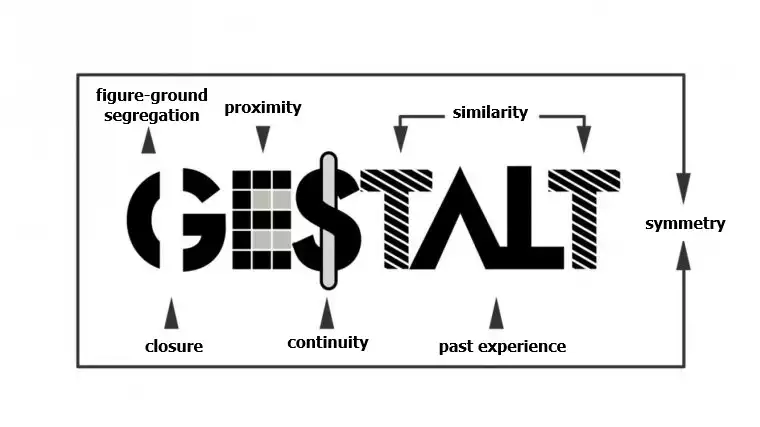
explained Gestalt theory and its principles. The following gestalt
psychology principles describe the way human perception works and how we assign
meaning to objects and events.
Close proximity
This principle states that when the human eye
sees elements that are placed close together, we consider these elements as a
set or group. An example of this is the way we read a text. When
letters are grouped together, our perception is that they form a word.
Likeness
A second way in which people tend to group
elements in their visual field is by looking for similarities. Elements
that look alike are automatically grouped together. For example, when you
watch a sports game and see people wearing the same color shirts, you see them
as members of the same team.
Continuation
Another part of Gestalt psychology is the
principle of continuation, which states that the human eye prefers to see a
continuous line or movement rather than separate elements. For example,
when we see a sign on a building where a tree is partly in front of the letter
x, we still recognize that letter and can read the sign without any
problems. We see the continuity of the lines.
Closedness
This principle explains that people have a
preference for complete elements. When we see things that are incomplete,
we can fill in missing information to see it as complete anyway. This
principle is often applied in the advertising world. Advertisers come up
with incomplete statements that people can then finish. With this
approach, they hope to generate interest and engage their audience more.
Figure-ground
The principle of figure and ground shows how
people distinguish between figures and the ground in their visual
field. The figure is the object that is central to our visual field, the
ground is less present and is placed in the background. This explains how
one person’s perception of an object or situation may differ from someone else’s:
it depends on what is seen as the figure and what is seen as the
ground. This principle was applied by the Danish psychologist Edgar Rubin,
who experimented with optical illusions.
Common destination
Another principle of Gestalt psychology is
that of common destiny. When the human eye sees elements moving together
in a certain direction, they are usually considered as a group. An example
of a common destination is seeing children running to the playground together,
thus seeing them as a whole. It is possible to separate the elements when
we do this consciously.
Pragnänz’s law
It is impossible to constantly spend time and energy on everything around us. We therefore tend to arrange the elements we see as simply as possible. The human mind prefers simplicity, so we try to simplify what we perceive. For example, when we see a car, we don’t need additional information to understand what we are looking at. This is called Pragnänz’s law. Pragnänz is a German word that can be translated as brevity.
In addition to the above principles that help
us understand how human perception works, Gestalt theorists also recognize that
the way we see the world is also influenced by other factors, such as
personality, expectations and experiences.
Example of Gestalt
Psychology
The example below is used to explain Gestalt
psychology:
When there is no movement, people can still perceive movement, which was also
the case with the two flashing lights that led to the phi phenomenon. For
example, a film consists of a series of separate images, but by playing them in
quick succession, we see a continuous movement that is not actually
there. According to Gestalt psychologists, this is because our brains fill
in the missing information. In this example, the missing information is
the gaps between the images. This shows that the ‘whole’ plays a more
important role in our brain than the sum of separate parts.
Application of Gestalt
Psychology
Basic Psychology
Basic psychological processes, such as
perception and attention, are strongly influenced by Gestalt
psychology. These basic psychological processes are fundamental and are
applied to practical matters. Developments within this research area are
applied, for example, in programs to improve signage to prevent
accidents. This is only possible with the knowledge we have about
perception.
Communication
To be able to grab the attention of the
public, people in communicative and creative fields work with Gestalt
psychology. For people active as an artist, journalist or designer it is
important to understand how the human mind interprets images. This
knowledge can help them to produce works that convey the right message to their
target audience.
Troubleshooting
In order to solve a problem, you must first
understand it. Gestalt psychology believes that a problem consists of
parts that are related and interact with each other. To fix the problem,
rearrange these parts so that you can see a new solution. This creative
rearrangement of the parts of a problem is called productive
thinking. Gestalt psychologists recommend applying productive thinking
when addressing various challenges.
Education
Within education, Gestalt psychology is
applied to perception and problem solving. The application of gestalt
psychology in education states that teachers should encourage their students to
solve a problem by looking at the different parts of a problem and the
interrelationships.
Therapy
Gestalt psychology-based therapy is a
humanistic approach in which people are seen as strong and independent
beings. It looks at the functioning of the human mind from a holistic
perspective where each person has his or her own thoughts, experiences and
reality.
The development of Gestalt therapy began in
the 1940s with psychiatrist Fritz Perls. He argued that each person has
his or her own reality that is determined by our own perception, and that it is
our responsibility to change our perception. This way of thinking forms
the basis of Gestalt therapy, in which personal growth and identity building
are central.
The Gestalt Institute
in Cleveland
The Gestalt Institute in Cleveland attracts people from all over the world. The institute organizes workshops and training programs based on Gestalt principles and methodologies. The workshops and training programs focus on change, both at the individual and organizational level.
Daily practice
Gestalt psychology can also be applied to
daily practice. As indicated in this article, Gestalt psychology can be
used to solve problems and stimulate creativity. In addition, being aware
of Gestalt principles helps us to understand how we perceive the world, how
optical illusions work and to understand our own behavior.
Now it’s your turn
What do you
think? Do you understand the
explanation of Gestalt psychology? Do you recognize the principles in the
way you perceive things yourself? Do you recognize Gestalt psychology in
the way the people around you perceive the world? Is there any way you
could apply Gestalt psychology in your work or study? Are there situations
where you do not perceive objects or events as a whole? Do you have any
comments or tips?
Share your knowledge and experience via the
comment field at the bottom of this article.
If you found the article useful or practical for your own knowledge, please share it with your network. Thank you very much in advanced.
This article explains the Charismatic leadership concept in a practical way. After reading you will understand the basics of this powerful leadership tool.
What is Charismatic Leadership?
Charismatic leadership is about personal conviction and is based on the leader’s charm and conviction. German sociologist and founder of bureaucracy theory , Max Weber introduced the term charismatic leadership in his essay The Tree Types of Legitimate Rule in 1958. Charismatic leadership is based on the personal qualities of the leader and his recognition by his followers, whereby is about an affective bond between the two. Max Weber saw charisma as an attribute of the individual, and it seems as if he / she is in possession of supernatural and exceptional powers.
Persuasiveness
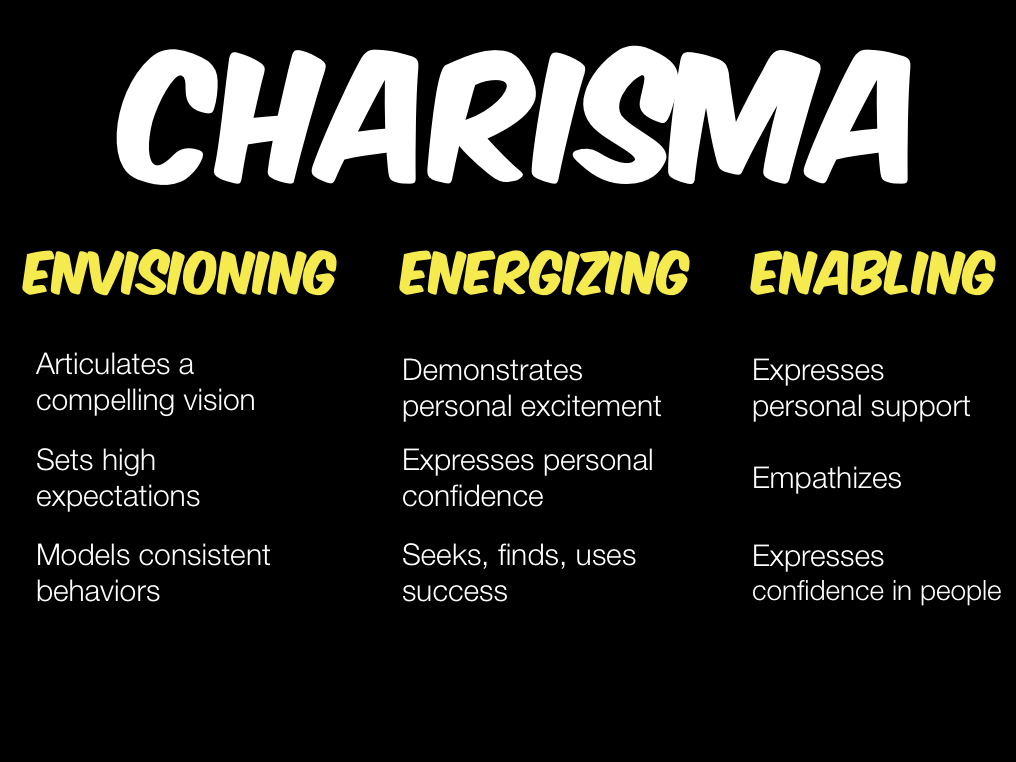
Charismatic leaders are driven by their beliefs and demonstrate exceptional dedication and expertise in their field. They have a clear vision and are able to inspire a large audience. Charismatic leadership stands or falls with the personality of the leader. In addition, they are powerful speakers and committed personalities. They can lift their employees to a higher level and encourage them to make positive changes. In addition, they are also able to communicate on an emotional and empathic level with their followers. In organizations where hierarchy plays a major role, employees will follow the rules and procedures established by their leader. That is possible in such a bureaucratic organizationaccomplished by a charismatic leader who motivates and stimulates them. In organizations where the mission and vision are central, the charismatic leader will focus more on building a strong emotional bond with the employees and inspiring and encouraging them.
Followers
Charismatic leaders do not necessarily have to be the best leaders. People tend to follow others they personally admire. A charismatic leader will gather followers through his personality and charm, rather than any form of power or authority. It actually goes without saying and it comes across naturally. In charismatic leadership, the personal vision of the leader has a lot of influence on his audience and appeals to their emotion. Originally, charismatic leadership is authoritarian, but today a charismatic leader has even more in store:
clear vision, which is conveyed well and clearly
interpersonal behavior; always in contact with others, empathetic and emotionally oriented
creating the sense of we
confident appearance
Attention and trust
The charismatic leader is able to give equal attention to each individual. He will scan his environment and take everything in well. He is sensitive to the mood and atmosphere at that moment and he will sharpen his actions and words and adapt them to the situation. Charismatic leaders also show great respect and trust to their supporters. They themselves are very convincing and they make effective use of both non-verbal communication (body language) and verbal communication (choice of words and language). For this they use story techniques, metaphors and symbolism. On an emotional level, they can focus attention on a group, give them confidence and make the group special.
The charismatic leader focuses on identifying the group. Charismatic leadership is often thought to correspond to transformational leadership . Charismatic leadership, however, does not aim to bring about a change, but focuses purely on enthusing and motivating employees.
Can you learn charismatic leadership?
Charismatic leadership is not a substitute for true leadership style. It is a good way of personal development, which can help a manager to be stronger in his shoes. Charismatic leadership is innate on the one hand, but with the necessary help from, for example, a personal coach, the basic skills can indeed be learned. Below is a step-by-step path to charismatic leadership:
1. Security
You must be sure that you want to become a charismatic leader. Not to tackle uncertainty, but to communicate your plans and focus within the organization to employees. Practice ‘management by speech’ and regularly go to the workplace to address employees, inspire them and inform them of information that is important to them.
2. Personal values
Think about your personal values and what motivates you. From this background it is easier to motivate and stimulate others. Stand behind your own views and those of the organization, so that you can communicate it well to others.
3. Appearance
Effective charismatic leaders are aware of their appearance and feel comfortable. Many characteristics of charisma are expressed physically. Be aware of your appearance and what effect this has on the environment.
4. Preparation
Good preparation is half the job. This certainly applies to presentations. Where it seems that a charismatic leader speaks loosely in front of a group of people, in many cases good preparation precedes. It comes down to correct choice of words, timing, taking a rest at the right moments, looking at a crowd and intonation and use of voice.
5. Exercise
The properties of charism contain both tangible (for example, public speaking) and intangible elements (for example, appearance). By practicing with a coach you can work on the correct intonation, choice of words and convey a powerful message.
Pitfalls
Pitfalls can be attached to charismatic leadership. For example, such leaders are often so convinced of themselves and their abilities that they believe they are infallible. This enables them to lead their followers to a possible abyss. Their self-confidence can also lead to narcissistic and bigoted behavior towards the environment.
Below are three more pitfalls of charismatic leadership:
Leaders can develop tunnel vision or arrogance and nullify their past good deeds.
Organizations can become too dependent on their charismatic leaders and can no longer develop their own vision; when the leader leaves, the company is nowhere and out of control.
Charismatic leaders tend to believe they are above the law and engage in certain behaviors that are not permitted by law or ethics.
Charismatic leaders examples
Several well-known charismatic leaders in history can already be identified on religious, political and business levels . Think for example of Martin Luther King , Barak Obama , Richard Brandson, Nelson Mandela and Steve Jobs.
All have the same in common; they are phenomenal public speakers, full of power behind the message they convey and responding to the feelings of their followers. Furthermore, they radiate inner peace, patience, empathy and compassion and they are able to motivate others. The world needs charismatic leaders because they fight for the quality of life and a better world. Charismatic leaders have the courage and conviction towards others and are willing to stand up to groups of people, organizations, society and the established order. In this way they can contribute to a common goal.
Now it’s your turn
What do you think? To what extent can Charismatic leadership be applied in today’s modern management environments? Do you recognize the above or do you have additions? What do you think are other success factors that can contribute to good charismatic leadership?
Share your knowledge and experience via the comment field at the bottom of this article.
If you found the article useful or practical for your own knowledge, please share it with your network to friends and business associates.
Exposing your feelings is not recommended in many situations. Statements like “don’t say anything if you don’t have anything nice to say” and thoughts like “expressing feelings is unprofessional” seem deeply rooted in our society. This applies in private situations and in the workplace, but also applies to leaders. Yet radical candor actually contributes to personal growth and gives you the opportunity to be the best version of yourself.
When we hide our feelings from others, we often do it because we don’t want to cause a stir or because we want to protect ourselves from criticism or not be excluded from the group. However, concealing how you really think or feel about something now only helps you in the short term. The price you pay by continuously pleasing is at the expense of your creativity, passion and motivation.
PRACTICE RADICAL CANDOR
With radical candor, we show our full selves to others. By practicing this you are authentic and you are vulnerable. You show that you support your own feelings, take others into account and give them the space to be candid. It is about connecting yourself and others, with care and feeling.
Examples of frankness in the workplace can be admitting as a manager that a new business strategy frightens you, sharing with colleagues that things are not going well for you and that there is something in your private life that distracts you, or telling your employer that his or her comment feels uncomfortable to you.
Openness not only ensures that you stay close to yourself, set your limits and do not suppress your feelings, it also creates space to grow together. Because how great would it be if you knew how everyone felt, if everyone dared to discuss everything in a respectful way and everyone would be heard and seen?
Hello folks.
Hope you are doing well so far in this COVID-19 period.
As I follow
what is happening in and around the world, I want to stick in this blog to
Design Thinking in Government. Especially that Caribbean Leaders need more
Design Thinking in Government to succeed more.
I am design
and created by mother nature. Everything is designed. Design is not only just
what it will looks like and feels like. Design is how it works. Everywhere you
can use design thinking. Yes even my car insurance company uses design.
Design
Thinking is nothing more then a user-centered (people centered) approach to
problem solving.
Actually in
my own opinion Design Thinking is less about thinking, but more about doing.
You just start from what people, users, customers, consumers etc. need or want
to do.
In this case
EMPATHY is the key. It is not about you. You need the ability to understand and
share the feelings of others a very good way.
Design
Thinking stimulates you to look at situations differently and come up with new
effective solutions that go beyond and improve existing alternatives.
Integrative
thinking is key. You need the ability to look at the different aspects of a
problem.
Stop
discussing start working. Make ideas tangible. Prototyping is thinking with
your hands. Test your hypnotises. I do hope you can follow me so far.
In daily
life, we experience how leaders are struggling to succeed. The road to success
does not follow a straight line. The more you are able to loop through
(understand, create, learn), the higher the chance you have for good results.
When things
aren’t running your way, this is the frustrating whirlwind ride we all go on.
Disagreements between people and parties keep us from making any stable form of
progress. They happen very often, and we are so uncompromising that Government
Shutdown might as well be considered a trend.
I my humble
opinion politicians live in a bubble, where they shut themselves in a cave for
a period of time only to emerge gloriously with ludicrously lengthy bills,
preaching their so called glory as if they reached their solution by grace and
wisdom of God. Furthermore they simply pass what they think they should pass;
sometimes they pass what has an earmark with their name on it. And if or when things fail, they repeal the
entirety of it, and try again.
In order for
Government especially in the Caribbean region to better serve their people,
their process should be user-centered9 people centered). Yes clear by the
people, for the people.
Leaders need
to thoroughly research the problems themselves. Who are the people most
affected by the problem. What is the problem, really! How does it impact the
people and how can we try to solve it, and never taking biased view from the
perspective of special interest groups or corporate entities that seek financial
or regulatory gain. Once we identify a problem and hypothesis, we test, Test
and iterate.
The easiest
way for us to start is to iterate upon that which already exists. The best
solutions come with research and iteration. And the iterations must be watched
with a sharp, keen eye, as to identify problems the instant they become
visible, so as to buffer any major impact they may create down to road.
For myself,
I work within the realm of user- centered design and its benefits are very
familiar to me. Design Thinking is a scientific, human-centered, and empathetic
process that yields the best designed solutions. It gets us together in to a
platform of understanding the people and their problems; with firm
understanding and empathy, along with daily continuous innovation, we can
create the best solutions.
With this
blog I hope that more people can and will agree that regardless of political
party of stance, a government educated and practicing design thinking methodologies
will help us all to establish/create a more perfect running country, community,
union etc.
Design
Thinking is not always the answer to every single problem. Keep that in mind.
For some
questions you will need rational thinking, spreadsheets, presentations and even
more women and men in suits to come to a valid answer. If you as a leader want
to become more effective train yourself in Design Thinking.
I am leaving you with the following words : Empathise, Observe, Engage, Watch and Listen….
Now that the new government has been formed in Suriname, it is more than ever time to think carefully about how to make Nickerie a top district of Suriname. We don't have to keep inventing the wheel. So many things are obvious to start with. In this blog I start generating electricity by the local population. We have the sun with us. Policymakers must work towards promoting the green economy. By bringing the people with you,

Nickerie will eventually grow into a sustainable energy district. Together with the local population and other actors, the self-generation of sustainable zone energy will give the district enormous support. Together, the energy transition will have an impact elsewhere in the country. Suriname is getting greener and greener.

As awareness increases, more people will contribute together to biodiversity, nature conservation and the quality of life of local communities.

ALWAYS GREEN

We must all go for more and more Green. It means that in our future (the new normal) many more people will use energy which they have generated themselves. Even if the sun is not shining, or if there is no wind and the generation of green electricity at that time is minimal, this is no problem.

A bit of technology is available for everything. It requires new developments and behavioral change. It is ambitious, but it is possible. If we do it together. Dare to dream big. Who knows, we may see a lot of people driving around with solar panels on the roof of their car[s].

As an active blogger, from time to time I will also focus on Suriname where I come from and stay. Sometimes the triggers may be less beautiful, but they are certainly constructive and offer eye openers to policy makers and other interested parties.

The
Regional
Blog
Authority



























![Caribbean [CARICOM] Leaders Need More Design Thinking In Government](https://blogzynergy.com/bz/wp-content/uploads/2020/07/ca1Od1596209722.png)